SFDR & Principal Adverse
Impact Reporting
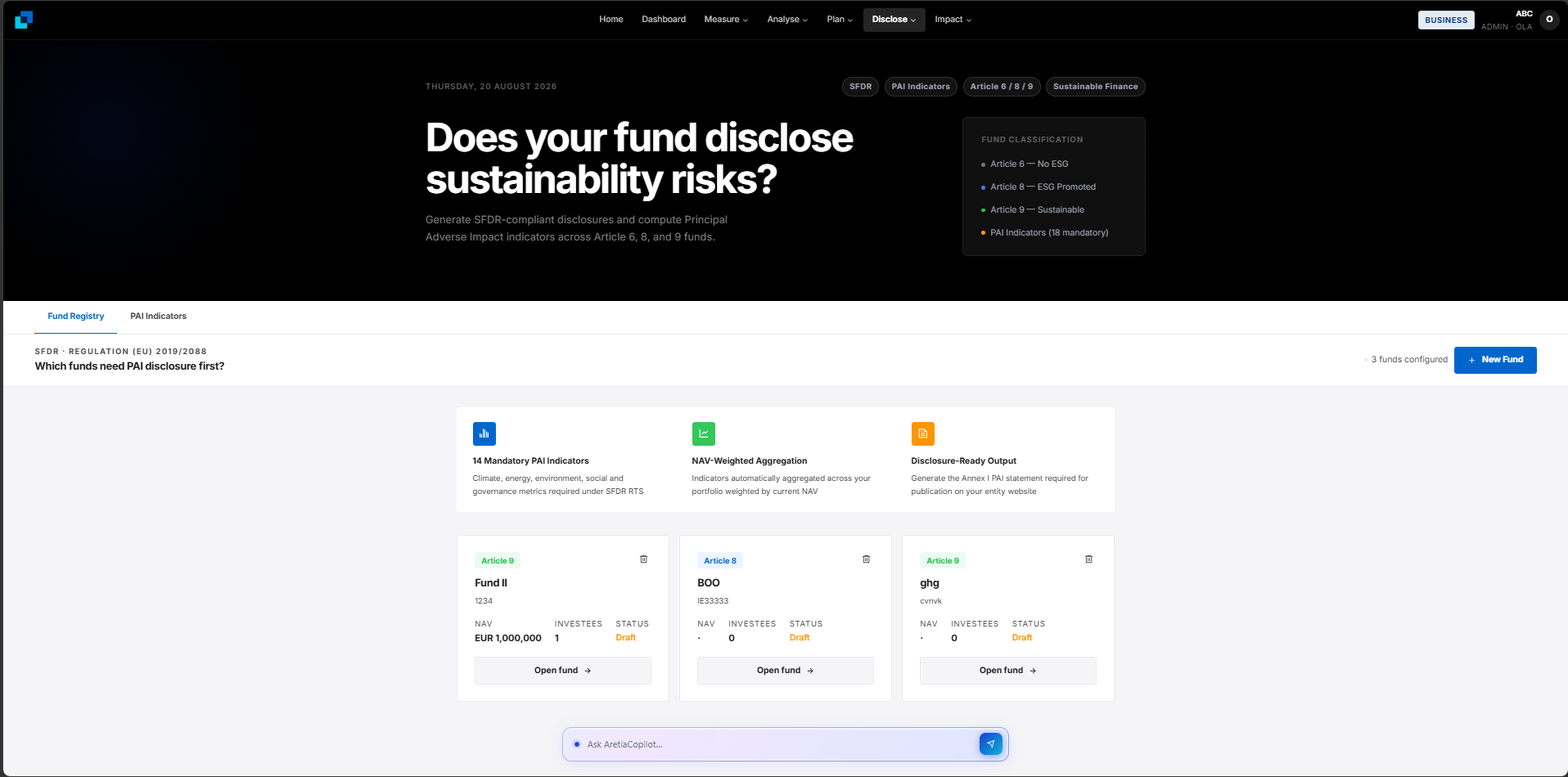
Collect investee-level data, aggregate all 14 mandatory PAI indicators using SFDR RTS methodology, and generate your Annex I disclosure statement — in one workflow.
In Scope
SFDR applies across the financial value chain
Any financial market participant managing or distributing investment products into the EU falls within scope — regardless of where the fund is domiciled or the manager is headquartered.
Asset managers
UCITS management companies and AIFMs managing Article 8 or 9 funds must publish an entity-level PAI statement and disclose product-level PAI indicators in pre-contractual and periodic reports.
Private equity & VC
Alternative Investment Fund Managers with EU investors require PAI disclosure under SFDR RTS regardless of fund domicile. EuVECA and EuSEF registration adds further transparency obligations.
Insurance companies
Insurers offering IBIPs and pension products under Solvency II must apply SFDR at both entity and product level, disclosing how sustainability risks are integrated into investment decisions.
Pension funds
Institutional pension providers (IORPs) with 500+ employees face mandatory entity-level PAI reporting. Smaller schemes must explain why they choose not to consider adverse impacts.
Wealth managers & banks
MiFID portfolio managers offering discretionary mandates are in-scope. From 2025, client suitability assessments must capture sustainability preferences aligned to SFDR product classifications.
Development finance
DFIs and development banks increasingly align to SFDR norms even when not legally required, reflecting LP expectations and the convergence of EU sustainable finance standards globally.
Classification Framework
Three fund classifications. Different obligations.
SFDR classifies investment products by their degree of sustainability integration. Each classification carries specific pre-contractual, website, and periodic reporting requirements.
The Indicators
All 14 mandatory PAI indicators. All five categories.
SFDR RTS Annex I Table 1 requires disclosure of 14 mandatory indicators. Aretia covers every one — with the correct aggregation method applied automatically per indicator.
- GHG emissions (Scope 1, 2 & 3)
- Carbon footprint per €M invested
- GHG intensity of investee revenue
- Fossil fuel sector exposure
- Non-renewable energy share
- Energy consumption intensity (high-impact sectors)
- Biodiversity-sensitive area activities
- Emissions to water
- Hazardous waste per €M invested
- UNGC / OECD violations exposure
- Absence of UNGC compliance process
- Gender pay gap
- Female board representation
- Controversial weapons involvement
Methodology
Five aggregation methods. Each indicator gets the right one.
SFDR RTS specifies different calculation methods depending on what each indicator measures. Aretia applies the correct method automatically — no manual formula building.
How It Works
Six steps. One Annex I statement.
From fund setup to signed-off disclosure — the full SFDR PAI workflow in a single platform.
Data Quality
Coverage tracked per indicator, not hidden in aggregates
Regulators and allocators scrutinise PAI data quality. Aretia shows coverage as a percentage of NAV for each indicator separately — so you know exactly where your data gaps are before you publish.
Example portfolio coverage breakdown. Your figures will vary.
Low coverage flagged
Indicators with under 50% NAV coverage are highlighted in amber — before you calculate, not after you file.
Source tracked per entry
Each investee's data point carries a source label: reported, estimated, proxy, or not available. The disclosure reflects actual data provenance.
Audit trail built in
Every data entry, calculation run, and export is logged with timestamp and user, supporting both internal review and external assurance.
Platform Integration
Investee data from GHG Inventory flows directly into PAI
When an investee company is also an Aretia client measuring their own GHG emissions, their Scope 1, 2 and 3 figures can be shared directly with your fund's PAI data entry — eliminating manual re-entry and improving data quality.
GHG Inventory
Scope 1, 2 & 3 emissions data from the investee's own measurement feeds PAI indicators 1–3 directly.
EU Taxonomy
Taxonomy alignment data identifies high-impact sector activities relevant to PAI indicator 6 (energy intensity).
Science-Based Targets
SBTi commitment status informs narrative disclosure on investee decarbonisation trajectory alongside PAI results.
Connected Platform Modules
Everything SFDR connects to on Aretia
SFDR PAI data is downstream of GHG measurement, EU Taxonomy screening, and science-based target setting. Use the connected modules to source, verify, and contextualise your investee data.
Investee Scope 1, 2 & 3 emissions flow directly into your fund's carbon footprint and GHG intensity PAI indicators — eliminating manual re-entry.
High-impact sector energy intensity data from taxonomy screening informs PAI indicator 6 (energy consumption intensity in high-impact sectors).
Investee SBTi commitments and validated targets provide narrative context for your PAI statement on decarbonisation trajectory.
GHG data and PAI results flow into your IFRS S2 Metrics & Targets pillar — giving institutional investors a joined-up view.
Physical hazard scores for investee locations give qualitative context to PAI disclosure on environmental adverse impacts.
Need help with PAI data collection, proxy estimation, or Annex I drafting? Request a consultant with SFDR expertise.
Common Questions
SFDR questions answered
Your 30 June deadline moves fast
Start collecting investee data now. A PAI statement needs a full calendar year of reference data — you can't compress the timeline.